差分约束
依然是先明确问题类型:
[!question]+ 问题描述
有 \(n\) 个待定的数 \(a_i\),要求满足 \(m\) 组操作满足:
\(a_i-a_j \le k\)
现在询问你是否有一组解 \(a_i\),满足上述要求。
首先我们可以将问题转换为图论问题,当我们 add(u,v,w), 及满足 \(a_v-a_u \le w\)
当我们同时观察两条头尾相接的边时,则有 add(x,y,w1), add(y,z,w2),既满足 \(a_y-a_x+a_z-a_y \le w_1+w_2\)。
及:\(a_z-a_x <= w_1+w_2\)。
当我们令 a[0]=inf,add(0,x,0) 时,显然可以直接计算 0 到每一个点 x 的 最段路 然后令 a[x] = dis,可以证明,此时 a[x] 最大。
但是如果路径中出现负环(如下),则一定无解:
[!example]+ 负环示例
对于下面这组
a[2]-a[1] >= 1
a[3]-a[2] >= 1
a[1]-a[3] >= 1
会连成:(未画 0)
其中出现了负环
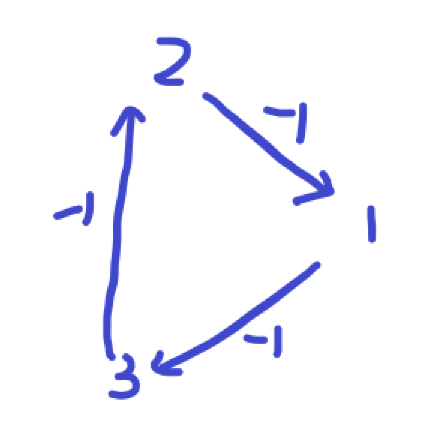
因此我们只需要判断一下图中是否有负环即可,可以用 spfa。
[!success]- CODE
#include<bits/stdc++.h>
using namespace std;
/*!@#$%^&*!@#$%^&*~~优美的分界线~~*&^%$#@!*&^%$#@!*/
const int N=1e4+5;
int n,m1,m2;
int dis[N],vis[N],cnt[N];
int tot,head[N],nxt[N<<1],ver[N<<1],edg[N<<1];
/*!@#$%^&*!@#$%^&*~~优美的分界线~~*&^%$#@!*&^%$#@!*/
void add_edg(int a,int b,int c){
  ver[++tot]=b,edg[tot]=c;
  nxt[tot]=head[a],head[a]=tot;
}
int spfa(int start){
  queue<int> Q;
  Q.push(start);
  memset(vis,0,sizeof vis);
  memset(cnt,0,sizeof cnt);
  memset(dis,0x3f,sizeof dis);
  dis[start]=0,vis[start]=1;
  while(!Q.empty()){
      int x=Q.front();Q.pop();
      vis[x]=0,cnt[x]++;
      for(int i=head[x];i;i=nxt[i]){
          int y=ver[i],w=edg[i];
          if(cnt[y]>n) return -1;//有负环
          if(dis[y]>dis[x]+w){
              dis[y]=dis[x]+w;
              if(vis[y]==0){
                  Q.push(y);
                  vis[y]=1;
              }
          }
      }
  }
  if(dis[n]>=0x3f3f3f3f) return -2;
  else return dis[n];
}
/*!@#$%^&*!@#$%^&*~~优美的分界线~~*&^%$#@!*&^%$#@!*/
signed main(){
  cin>>n>>m1>>m2;
  while(m1--){
      int a,b,d;cin>>a>>b>>d;
      add_edg(a,b,d);
  }
  while(m2--){
      int a,b,d;cin>>a>>b>>d;
      add_edg(b,a,-d);
  }
  for(int i=1;i<=n;i++) add_edg(0,i,0);
  for(int i=1;i<n;i++) add_edg(i+1,i,0);
  if(spfa(0)<=-1) cout<<spfa(0);
  else{
      cout<<spfa(1);
  }
  return 0;
}