左偏树
引入
二叉堆固然好(更有可能指的是 \(\texttt{priority_queue}\) ),但是如果遇到需要合并的操作,最直接的办法就是把两个堆的其中一个堆全部放到另一个堆中,时间复杂度 \(\mathcal O(N \log N)\) 。
但是此时我们令 外节点 为所有子节点个数不为 \(2\) 的节点,然后令 \(\texttt{dist}_x\) 为在 \(x\) 的子树中的 外节点 中(可以包含自己)距离的最小值。
对于一颗左偏树我们只需要在一颗二叉树上同时满足 "堆的性质" 和 "左子节点的 \(\texttt{dist}\) 大于右子节点"。其大致结构如图所示:
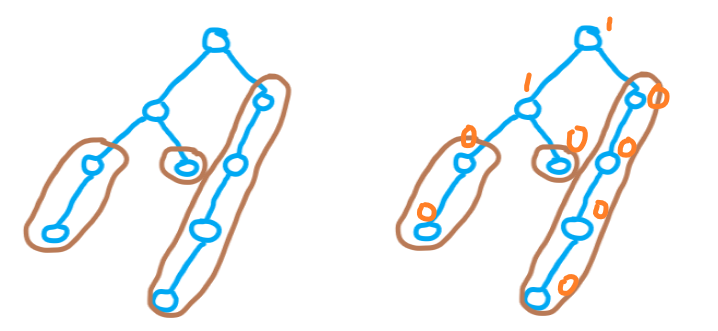
(这里右边的那副图的数字为 \(\texttt{dist}\))
可以发现所有的 外节点 组成了若干条左偏链,并且他们的 \(\texttt{dist}\) 为 \(0\) 。进一步观察,我们还发现对于节点 \(x\) ,其 \(dist_x = dis_{rc(x)} + 1\) ,这个就是为什么一般要把空节点设为 \(-1\) 。
合并操作
左偏树一切操作都是基于合并操作的。毕竟这个也就是二叉堆的短板。
每当我们尝试合并两个堆分别以 \(x,y\) 为根时,我们把他们两个值大的当作根,然后把权值小的和全职大的右子节点合并。
[!info]+ 时间复杂度
Step1: 首先我们可以证明时间复杂度是和 \(\texttt{dist}\) 成线性的:
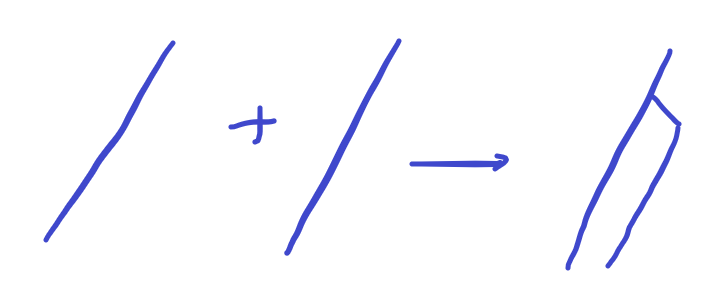
由于每一次往下走 \(\texttt{dist}\) 都会减去 \(1\) ,所以走了 \(\texttt{dist}\) 步之后 \(\texttt{dist} = 0\) ,相当于到了两个链上。 然而链的合并为:
只需要执行一次。
Step2: 然后还可以证明 \(\texttt{dist}\) 为 \(\log\) 级别的。
这个是因为对于一个节点 \(x\) ,令离他最近的 外节点 为 \(y\) ,那么 \(x \to y\) 的路径上全部节点都有两个子节点,所以类似树链剖分。直接证明出来了。
当然这里还有什么 随机堆 ,其他算法也可以达到相同效果。
[!success]- 参考代码
template<class T=int, class Cmp=less<T>>
struct KBH {
    /**
    * 这里一个数据结构同时维护多个序列
    * 然后每一个序列的编号为其top()
    */

    struct DSU {
        int fa[N];
        int find(int x) {
            if(x==fa[x]) return x;
            return fa[x]=find(fa[x]);
        }
        DSU() {for(int i=1; i<N; i++) fa[i]=i;}
    }dsu;

    int cnt;
    bool del[N];
    struct node {
        T val;
        int ls, rs;

        node(): val(0), ls(0), rs(0) {}
        node(T v): val(v), ls(0), rs(0) {}
    }tr[N];

    int merge(int x, int y) {
        if(!x || !y) return x|y;

        if(tr[x].val!=tr[y].val && !Cmp()(tr[x].val,tr[y].val) ) swap(x, y);
        if(tr[x].val==tr[y].val && x>y) swap(x, y);
        tr[x].rs=merge(tr[x].rs, y);

        swap(tr[x].ls, tr[x].rs);
        return x;
    }

    void join(int x, int y) {
        if(x==-1 || y==-1) return;
        dsu.fa[x]=dsu.fa[y]=merge(x,y);
    }

    // x 为需要插入的队列编号,返回插入节点标号
    int push(int x, T v) {
        tr[++cnt]=node(v);
        return merge(x, cnt);
    }

    // 创建一个新的队列,返回队列编号(节点编号)
    int new_que(T v) {
        tr[++cnt]=node(v);
        return cnt;
    }

    // 查询一个节点编号所在的队列
    int que(int x) {
        if(del[x]) return -1;
        int ans=dsu.find(x);
        return (del[ans])?-1:ans;
    }

    // 查询一个队列的 top
    int top(int x) {
        if(x==-1) return -1;
        return tr[x].val;
    }

    void pop(int x) {
        if(x==-1) return;
        del[x]=1;
        int new_root = merge(tr[x].ls, tr[x].rs);
        if(new_root) {
            dsu.fa[x]=new_root;
            dsu.fa[new_root]=new_root;
            dsu.fa[tr[x].ls]=new_root;
            dsu.fa[tr[x].rs]=new_root;
        }
    }
};